
This site contains affiliate links, view the disclaimer page for more information.
Ghent is the Belgian city that nobody warned me about, and honestly, I’m a little annoyed about that.
I’d spent a few days in Bruges before making my way to Ghent, and like most visitors to Belgium, I assumed Bruges would be the highlight. The canals, the chocolate shops, the Instagram-perfect reflections in the water. And Bruges is beautiful, genuinely so. But Ghent crept up on me in a way I didn’t expect. By the end of the day, I was already thinking about when I could come back.
If you’re planning a trip to Belgium and you’re trying to decide whether Ghent is worth your time, let me save you the deliberation: it absolutely is.
Table of Contents
Getting to Ghent
I arrived from Bruges, which is one of the great low-effort train journeys in Europe. It took about 30 minutes, cost next to nothing, and dropped me directly into the centre of one of the most beautiful medieval cities on the continent. No transfers, no fuss.
Ghent is also very easily accessible from Brussels, with trains running frequently and the journey taking around 35 minutes. If you’re basing yourself in the capital and looking for a day trip, Ghent is honestly a better choice than Bruges for reasons I’ll get into later. Either way, Belgian rail is your friend here. There is no reason to rent a car.
What struck me immediately stepping out of the station was that this felt like a city that was going about its day. Students on bikes. A market spilling onto a side street. Locals grabbing coffee without a selfie stick in sight. That feeling set the tone for everything that followed.
Where I Stayed: 1898 The Post
I stayed at 1898 The Post, and I want to spend a moment on this because it genuinely shaped the whole experience of being in Ghent.
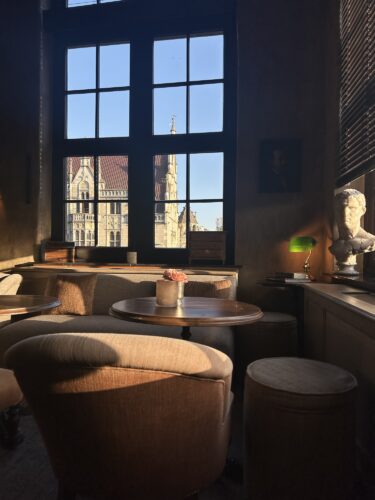
The hotel is housed inside a former post office building right in the heart of the city. When they say “former post office,” they mean a grand, vaulted, beautifully ornate piece of 19th-century civic architecture that has been converted into a luxury hotel without losing any of its original character. Checking in felt like walking into a different century.
The ceilings are extraordinary. The ironwork is extraordinary. The location is extraordinary. It sits within walking distance of every major sight in the city, which meant I never once needed to think about transport during my entire visit. I just walked out the door and started exploring.
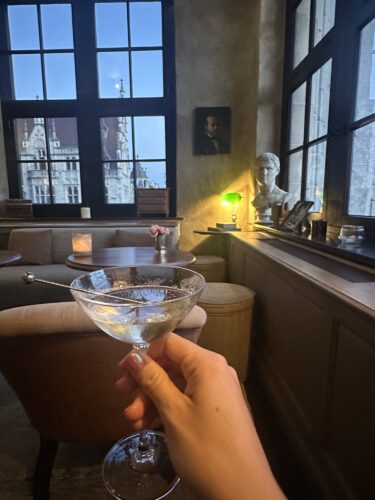
But the part I want to highlight specifically is The Cobbler, the hotel’s bar. After a full day on my feet covering most of the old city, I sat down at The Cobbler for a drink before dinner and it quickly became the best decision of the day. The bar has a warmth and a character that matches the building it’s inside, and the drinks list is thoughtfully put together. If you’re staying at 1898 The Post, do not rush past The Cobbler. Sit down, order something interesting, and let the day settle around you. It’s the kind of bar that makes you feel like you’ve earned your evening.
The View from St Michael’s Bridge
Here is my first proper piece of advice for visiting Ghent: before you do anything else, walk to St Michael’s Bridge and just stand there for a while.
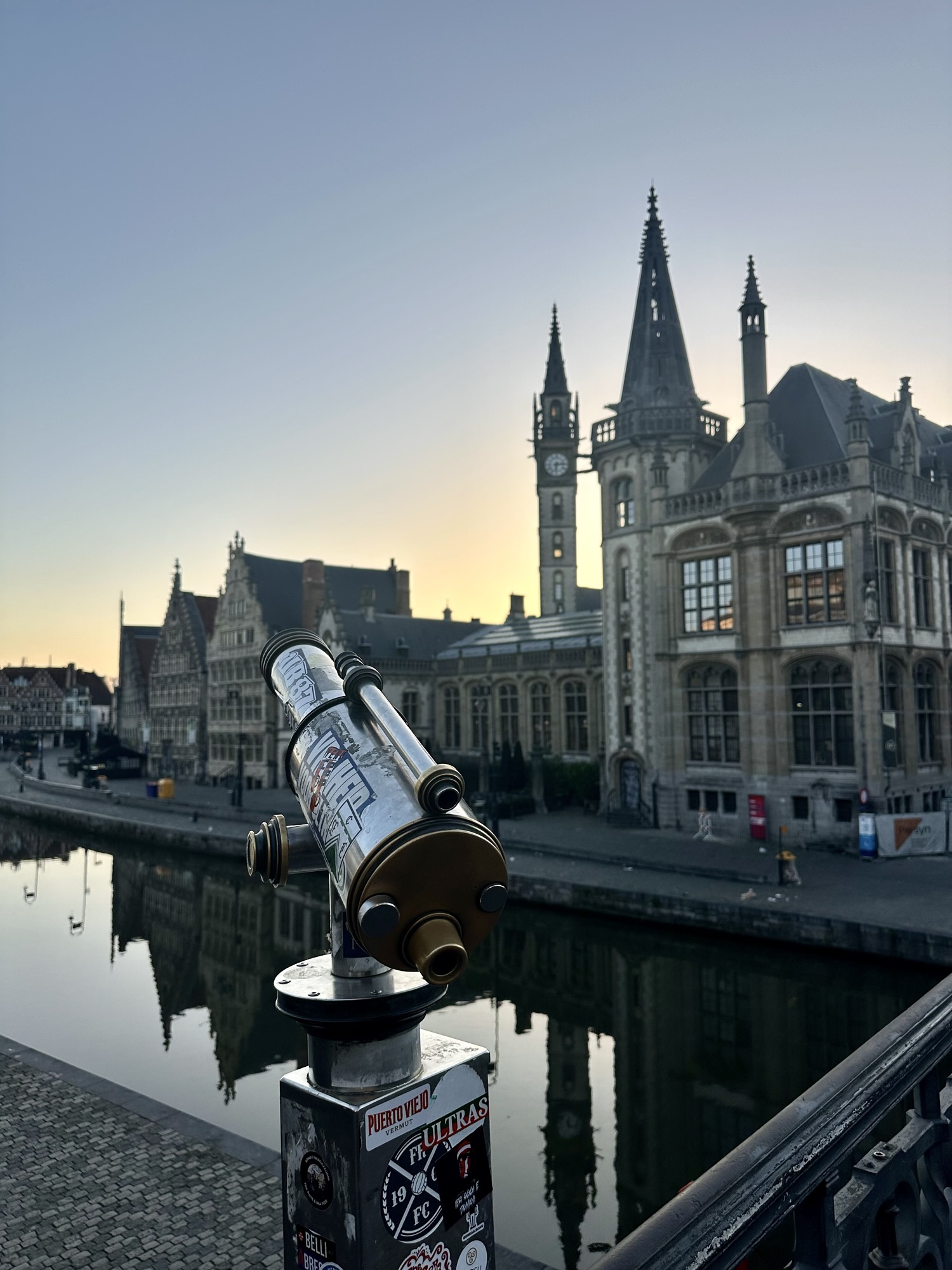
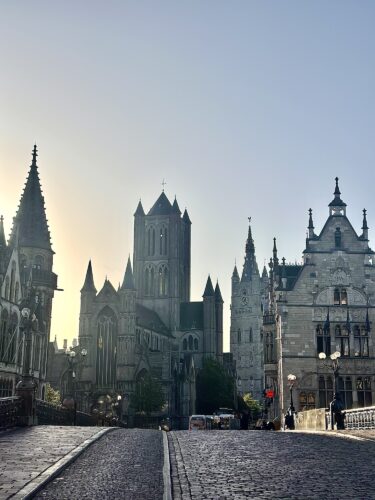
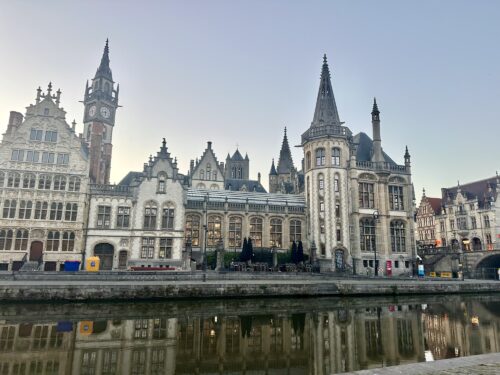
The view from that bridge is one of the finest urban panoramas I have ever seen. You are looking directly at the Graslei and Korenlei, the two historic quays that line either side of the river, with their guild houses and merchant buildings reflected in the water below. Behind them, the towers of St Nicholas’ Church, the Belfort, and St Bavo’s Cathedral rise against the sky in a row that feels almost too perfectly composed to be real.
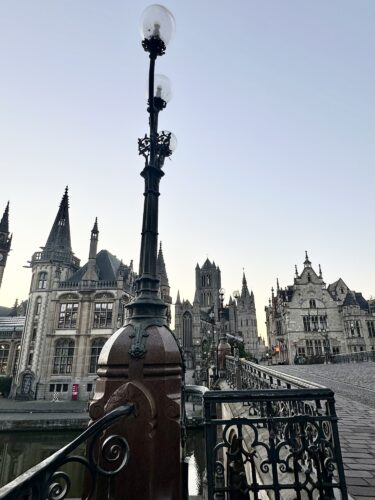
I took about forty photographs from that bridge and none of them did it justice. There’s something about standing there in person, with the smell of the water and the sound of the city around you, that a photograph simply cannot capture. Go early if you can. The light in the morning is something else, and you’ll have more of the bridge to yourself.
Walking the Canals
Ghent is a canal city, and the best thing you can do after admiring the view from St Michael’s Bridge is to simply follow the water.
The canal walks in Ghent are not a tourist attraction in the organised sense. There are no tickets to buy, no audio guides to hire, no rope barriers keeping you at a respectful distance. You just walk along the water at your own pace and let the city happen around you.
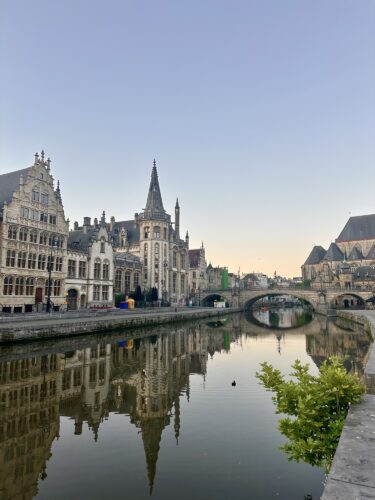
What I love about this is the mix you encounter. Around one corner there’s a medieval stone facade that’s been standing for six hundred years. Around the next there’s a terrace bar full of students drinking in the afternoon sun. Ghent manages to be simultaneously ancient and completely alive, and the canals are where that combination feels most natural.
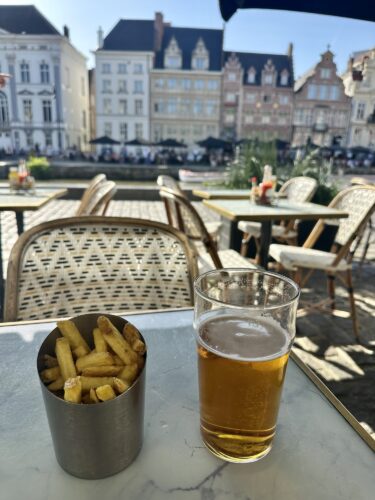
Stop somewhere for a drink or something to eat when the mood takes you. There are plenty of options along the waterfront, from traditional Belgian cafes serving local beers to more casual spots with simple food and good coffee. Don’t plan this too rigidly. The point is to wander.
Gravensteen Castle: More Fun Than It Has Any Right to Be
Gravensteen is Ghent’s 12th-century castle, and it sits right in the middle of the city like it never got the memo that the medieval period ended. Complete with towers, ramparts, a moat, and a genuinely menacing silhouette, it is the kind of building that makes children immediately want to draw it.
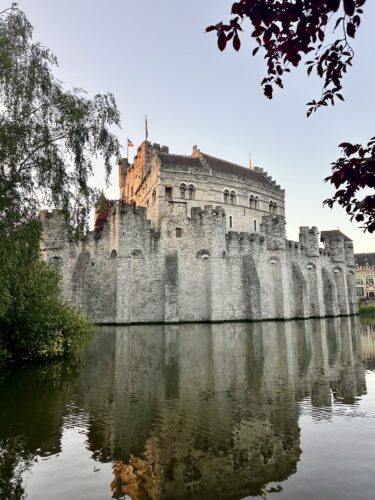
I spent over an hour inside and could have easily stayed longer.
A few important things to know before you go:
- Book your tickets online in advance. Gravensteen regularly sells out, especially during peak season. I cannot stress this enough. Turn up without a booking and you may find yourself standing outside a magnificent castle with no way in. The online booking process is straightforward and takes five minutes.
- Arrive as early as you can. The castle gets busy as the morning progresses, and the rooftop walkways feel very different when you have them to yourself versus when you’re shuffling around in a queue.
- Choose the comedy audio tour. This is the piece of advice I wish someone had given me before I visited. Gravensteen offers two audio tours: a standard historical one and an alternative comedy version that approaches the castle’s rather brutal history with a tone that is distinctly, brilliantly Belgian. It’s irreverent, witty, and strangely informative. I ended up learning more from the comedy tour precisely because I was actually engaged with it rather than half-listening while looking at the stonework.
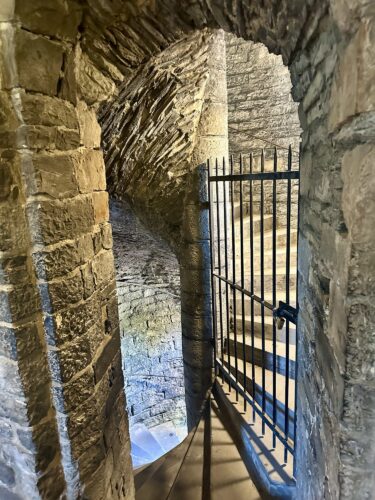
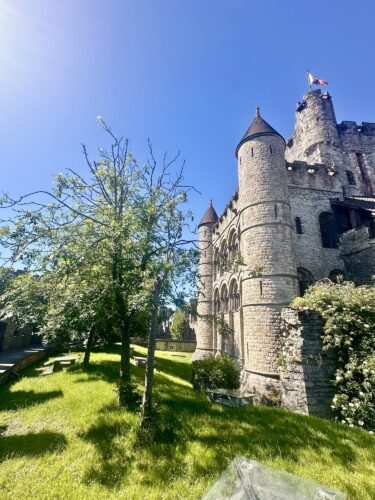
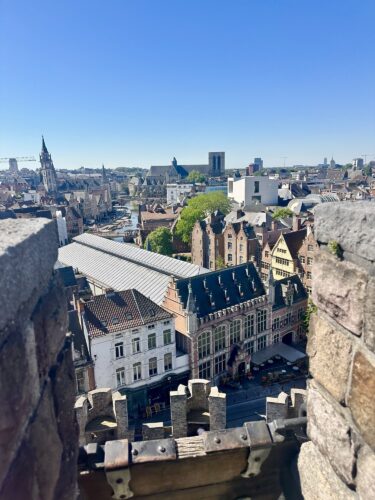
The views from the top of the castle walls are excellent, and you get a real sense of how the city has grown up around this structure over the centuries. What was once a fortification at the edge of civilisation is now surrounded by cafes and cycle lanes. There’s something quietly funny about that.
St Nicholas’ Church: Don’t Walk Past It
I’ll be honest with you. By mid-morning, after the castle, I was experiencing a mild version of what I’d call “European church fatigue.” You know the feeling. You’ve been on the road for a few days, you’ve seen a lot of beautiful old buildings, and your brain starts to register Gothic architecture as background noise rather than something to actually look at. St Nicholas’ Church cured me of that immediately.
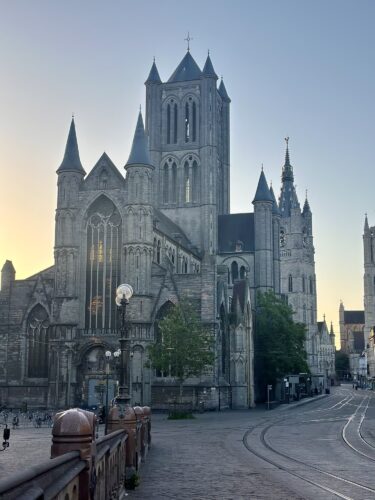
The church stands on the Korenmarkt, Ghent’s main market square, and it is free to enter. The exterior is striking, but it’s the interior that gets you. There’s a quality of light inside St Nicholas’ that I haven’t experienced in many other churches, a kind of stillness that makes the space feel genuinely sacred rather than merely historical. The Gothic architecture is immaculate, the restoration work clearly done with care, and the overall effect is of a building that still means something rather than one that’s simply being preserved.
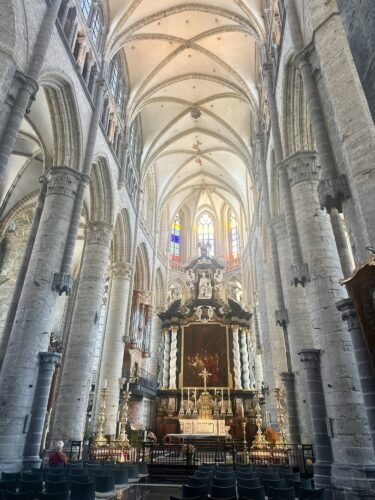
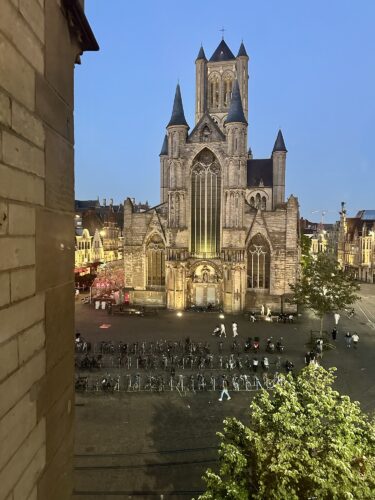
Even if you think you’ve seen enough churches, go inside. It takes 20 minutes and you won’t regret it.
Climbing the Belfort
The Belfort, Ghent’s medieval belfry, is a UNESCO World Heritage Site and one of the defining features of the city’s skyline. You can see it from almost everywhere in the old town, and at some point during your visit, you’ll find yourself wondering what the view looks like from the top.
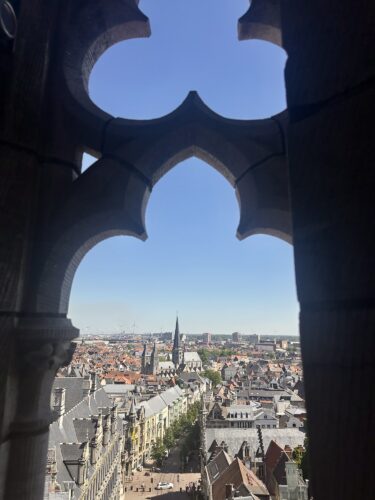
The answer is: very good.
The climb is worth doing for the views alone. Ghent from above is a different city from Ghent at street level. You can see how the canals thread through the urban fabric, how the churches cluster together in the old centre, how the city gradually softens into residential neighbourhoods as it spreads outward. It’s the kind of perspective that makes everything you’ve seen at ground level click into place.
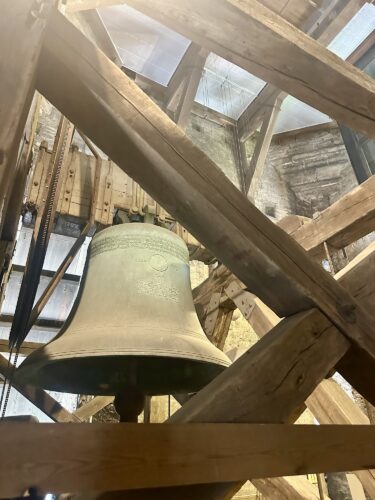
But what I didn’t expect was how interesting the journey up would be. The Belfort functions as a museum as well as a viewpoint, and the exhibits inside trace the history of Ghent through the story of its bells and its civic governance. Ghent has a long, proud history of independence and resistance, and the Belfort was central to that. The city’s most important documents were stored here. The bell summoned citizens to defend their freedoms. This wasn’t just a tower; it was a symbol of what the city believed about itself.
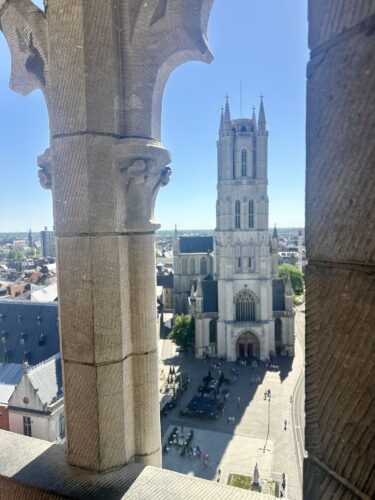
That context made the view from the top feel more meaningful. I wasn’t just looking at a pretty skyline. I was looking at a city with a spine.
Ghent vs Bruges: An Honest Comparison
This is the question everyone asks, and it deserves a proper answer rather than a diplomatic non-answer.
Both cities are in the Flemish region of Belgium. Both have medieval centres, beautiful canals, and exceptional food. Both are accessible by train from Brussels and from each other. On paper, they’re similar. In practice, they feel completely different.
Bruges is a masterpiece of preservation. Walking through the historic centre of Bruges is like walking through a film set that happens to be real. Every street is immaculate. Every building is perfect. The city has been so thoroughly curated for tourism that it can feel, especially in summer, like a heritage experience rather than a place where people actually live.
That’s not a criticism, exactly. Bruges is genuinely beautiful and if you haven’t been, you should go. But it comes with a caveat: you will share it with a very large number of other people who have also been told they should go, and that changes how it feels to be there.
Ghent is different. Ghent has a large university, a significant student population, and a cultural life that exists entirely independently of its tourist industry. When I walked through Ghent, I felt like I was passing through a city that was busy with its own concerns. The restaurants had menus that hadn’t been translated into six languages. The bars had locals in them. The streets had people cycling to places they actually needed to be.
This gave Ghent a quality that I find hard to put into words but easy to recognise: it felt real.
The architecture in Ghent is every bit as impressive as Bruges. The canals are just as beautiful. The food is just as good. But Ghent hasn’t handed itself over to tourism in the same way, and that difference makes wandering through it feel like a genuine discovery rather than a guided experience.
If I had to make a recommendation: visit both if you can. If you can only visit one and you want to feel like a traveller rather than a tourist, choose Ghent.
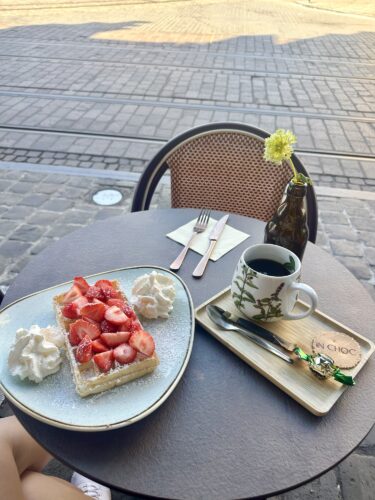
Practical Tips for Your Day in Ghent
A few things I learned that are worth passing on:
- Wear comfortable shoes. The old city centre is largely cobblestoned and you will cover a lot of ground on foot. This is not a complaint. It’s just a fact.
- Book Gravensteen tickets online before you travel. I mentioned this already but I’ll say it again because it genuinely matters.
- The canal walk between the Graslei and the Korenlei is best in the morning. Later in the day the waterfront fills up, which is lovely in its own way, but the early morning light on the guild houses is something you’ll remember.
- Allow more time than you think you need for Gravensteen. Most people budget 45 minutes and end up staying for an hour and a half. The comedy audio tour is longer than the standard one and you’ll want to see everything it draws your attention to.
- End your day at The Cobbler bar at 1898 The Post. Even if you’re not staying at the hotel, the bar is worth a visit. It’s a beautiful space inside a remarkable building, and after a full day in the city, sitting down with a well-made drink in a room with that much character is a proper reward.
- Ghent is a student city. This means there are excellent, affordable restaurants and bars alongside the more upscale options. Don’t feel like you need to spend a lot of money to eat and drink well here.
What to Pack for Visiting Ghent
Ghent is a walkable, cobblestoned city, so what you bring makes a real difference to how comfortable your day is. Here’s what I’d recommend:
- Comfortable walking shoes. Non-negotiable. The old city centre is almost entirely cobblestone and you will cover several miles on foot without really noticing. Stylish but practical wins here.
- A reusable water bottle. You’ll be on your feet all day and there are plenty of places to refill.
- A portable phone charger. You will take more photos than you expect, especially from St Michael’s Bridge and the top of the Belfort.
- Cash. Most places in Ghent accept cards, but smaller cafes, market stalls, and the occasional canal-side bar still prefer cash. A small amount goes a long way.
- A crossbody bag or daypack. Hands-free is the only way to walk a city like Ghent properly.
Go to Ghent
I came to Ghent expecting to like it. I left wanting to move there. That might be an overreaction. But there’s something about Ghent that gets under your skin in a way that very few cities manage. It has the bones of a world-class historic city, the energy of a university town, and the self-possession of a place that doesn’t need to impress you to feel confident about what it is.
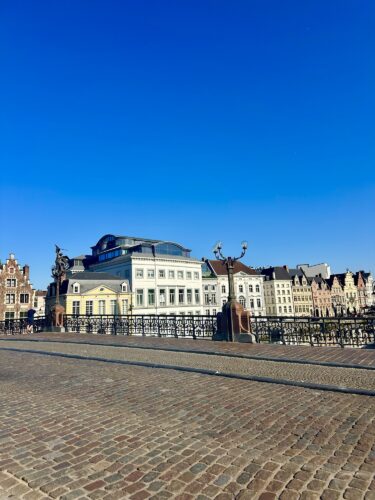
It’s not trying to be Bruges. It’s not trying to be Brussels. It’s just being Ghent, and Ghent turns out to be more than enough.
If you’re traveling through Belgium and you’re weighing up where to spend your time, put Ghent on the list. Book your castle tickets early, choose the comedy audio tour, climb the Belfort, linger on St Michael’s Bridge longer than feels strictly necessary, and finish the day at The Cobbler with something cold in your hand.
You can thank me later.
With love,
Bri and Cat
Affiliate Disclaimer:
As an Amazon Associate I earn from qualifying purchases. This comes at no additional cost to you. We only recommend products that we believe will add value to our readers.
Leave a Reply