
This site contains affiliate links, view the disclaimer page for more information.
One day in Bruges might sound like it is not enough, and honestly, after spending two nights there in late May, I completely understand why so many people wish they had stayed longer. I took the train from Brussels, arrived with one full day to explore, and came home completely smitten with this medieval canal city. If you are planning a trip and wondering whether Bruges is worth it, the short answer is: absolutely yes. Here is everything I did, everything I wish I had done, and everything you need to know to make the most of your time there.
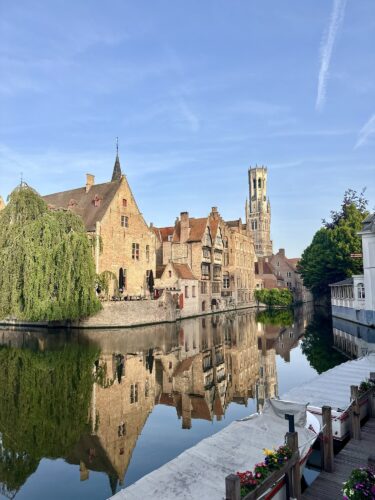
Table of Contents
Getting to Bruges: Easier Than You Think
Let me start with the logistics because the ease of getting to Bruges genuinely surprised me. I took the train directly from Brussels, and it was one of the smoothest travel experiences I have had in Europe. The journey takes just under an hour, the trains run frequently throughout the day, and the Bruges train station drops you within easy walking distance of the city centre. No car hire, no complicated transfers, no stress.
If you are already in Brussels for a night or two, adding Bruges as a day trip or a short overnight stay is a no-brainer. It is genuinely that convenient. I decided to stay two nights so I could enjoy one full day without rushing, and that turned out to be exactly the right call. Two nights gives you a real evening in the city as well, when the day trippers have headed home, the restaurants fill with people who are actually staying, and Bruges takes on a completely different, quieter energy.
One practical note: the train from Brussels runs to Bruges Centraal station roughly twice an hour throughout the day, so there is no need to plan too rigidly around departure times. Buy your ticket in advance online for slightly cheaper fares, pack light, and just enjoy the fact that one of the most beautiful cities in Europe is less than an hour away from the Belgian capital.
Is Bruges Too Touristy?
I want to address this head on because you will see it come up in every travel forum: yes, Bruges is touristy. Very touristy. I visited in late May, and by mid-morning the main squares and canal-side streets were buzzing with tour groups, day trippers, and visitors from all over the world. The boat tour queues filled up fast. The chocolate shops had lines snaking out the door.
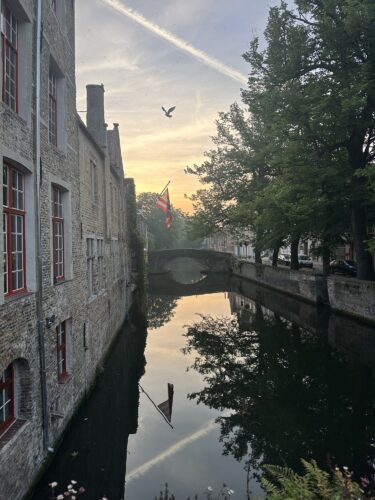
And you know what? It did not matter. Bruges is touristy because it deserves to be. The city has preserved a level of medieval architectural beauty that you simply do not find anywhere else in Western Europe. Every canal, every gabled roofline, every cobblestone lane looks like it belongs on a postcard. The crowds exist because people have been coming here for centuries, and they keep coming back.
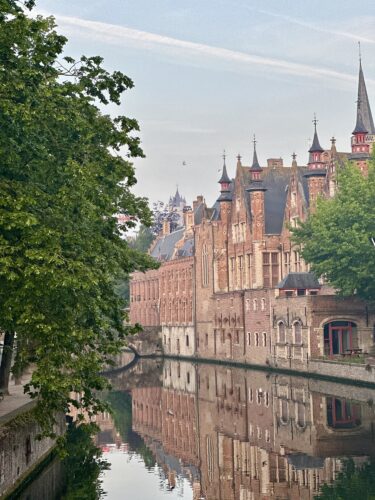
Part of what makes Bruges so remarkable is that it largely escaped the industrial development and wartime destruction that reshaped so many European cities in the 19th and 20th centuries. What you are walking through is not a reconstruction or a heritage theme park. It is the real thing. Buildings that have stood for 500 or 600 years, canals that were once busy trading arteries, churches that were built when Bruges was one of the wealthiest and most important cities in all of Europe. The tourists are just the latest wave of admirers in a very long line.
The trick is not to avoid Bruges because of the tourists. The trick is to get up early.
Where I Stayed: Dukes’ Arches Hotel
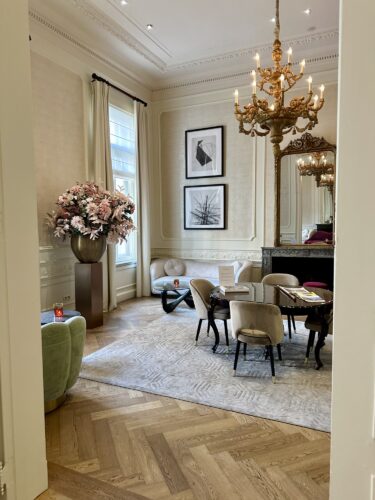
I stayed at the Dukes’ Arches hotel and loved it. The location was ideal for exploring on foot, the rooms were comfortable, and the whole place had a warmth and character that matched the city around it. The hotel is housed in a beautifully restored historic building and feels genuinely rooted in the city rather than dropped into it, which makes a difference when you are somewhere as architecturally rich as Bruges. I would happily stay there again.
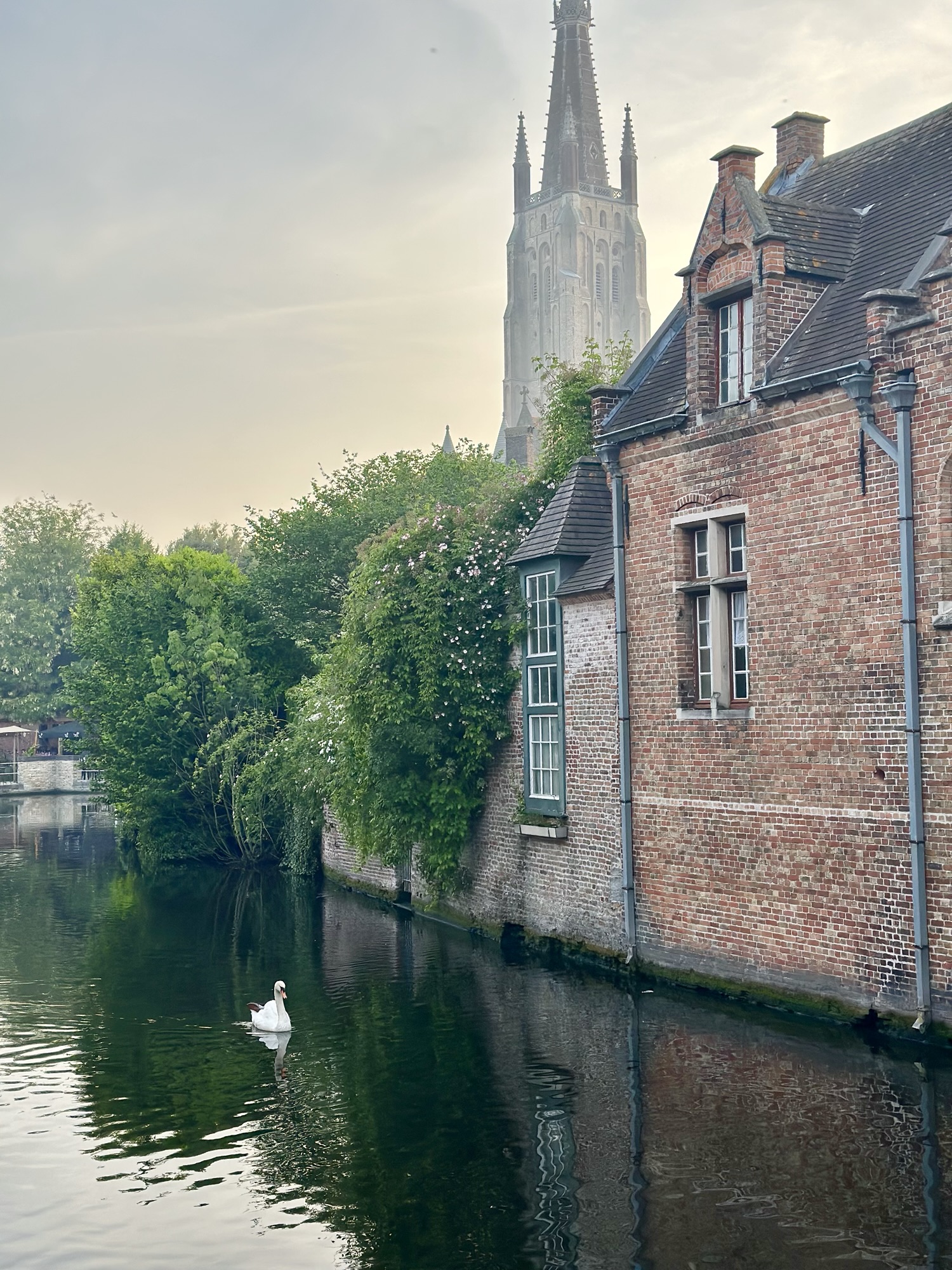
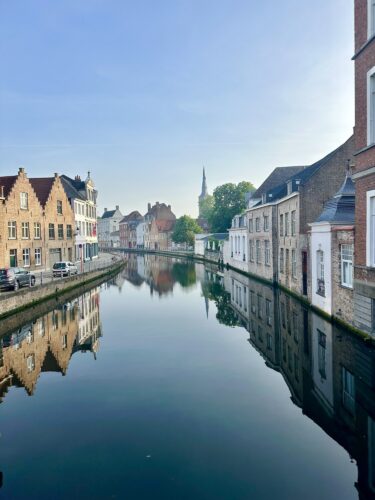
More importantly, staying centrally meant that on my first morning, I was able to step outside before the day crowds arrived and just walk. No agenda, no map app, just wandering through quiet streets with my coffee. That early morning hour in Bruges might have been the highlight of the entire trip. The light on the water, the silence, the sense that you have an ancient city almost entirely to yourself. I cannot recommend it enough. Set your alarm for 7am. You will thank me.
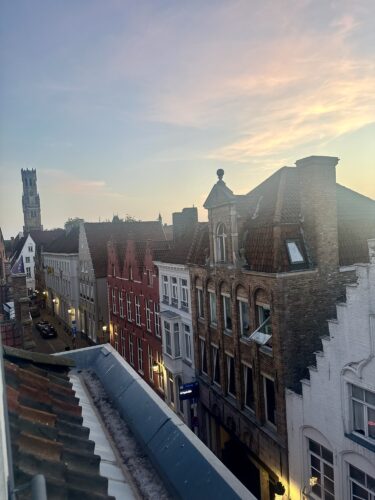
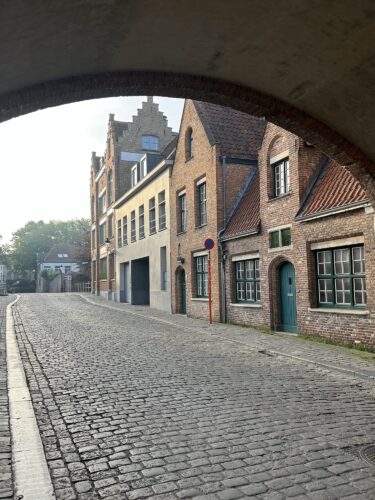
There is something about Bruges in the early morning that is hard to put into words without sounding like a travel cliche, so I will try to be specific. The streets are damp and reflect the light. The canal water is completely still. The only sounds are birds, the occasional bicycle, and your own footsteps on cobblestones that have been worn smooth over hundreds of years. It is the kind of quiet that resets something in you. Do not waste it lying in bed.
A Full Day in Bruges: How I Spent It
Morning: Walk the Canals to Minnewater Park
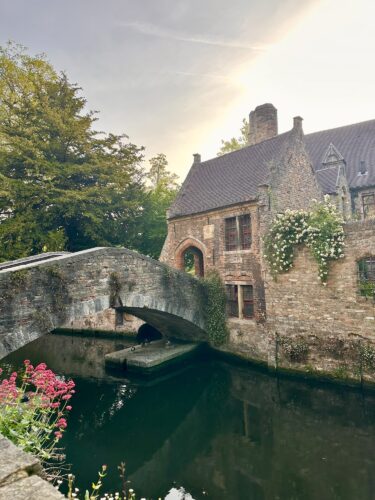
My first stop on a proper one day in Bruges itinerary has to be the canals. The canal network winds through the entire city, and walking alongside it is one of those travel experiences that feels effortless and completely absorbing at the same time. You never feel like you are ticking off a route. You just keep following the water and things keep being beautiful.
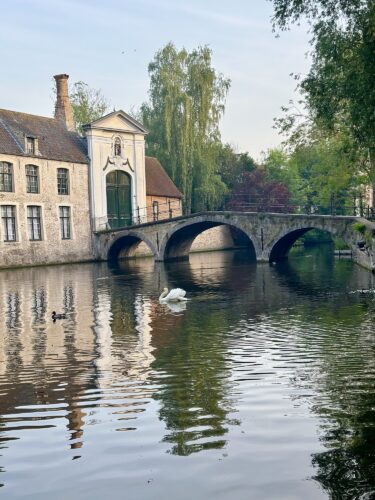
I made my way south to Minnewater Park, known locally as the Lake of Love, to see the famous swans. The walk from the centre takes about fifteen minutes and takes you through some of the quietest and loveliest streets in the city. On a late May morning before the crowds arrived, I had long stretches of canal path almost entirely to myself. This is why the early start matters.
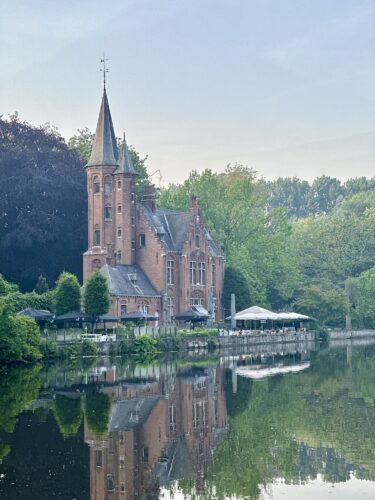
The swans at Minnewater are something else. They glide around in large numbers, utterly unbothered by the humans photographing them from every angle, and the park itself is quietly beautiful with weeping willows trailing into the water and ducks patrolling the edges. It is an ideal first stop because it is a bit of a walk from the centre, which means fewer crowds early in the morning, and the route there takes you through some of the loveliest canal-side streets in the city.
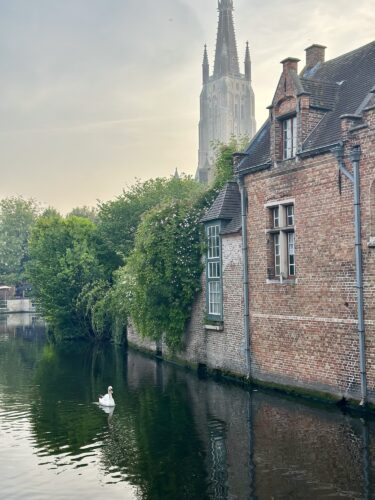
Give yourself time to just wander. Sit on a bench for a few minutes if you can. Do not rush this part.
The Markt: The Heart of the City
After Minnewater, I headed back toward the Markt, and I would encourage you to spend a proper amount of time here rather than treating it as a thoroughfare you pass through on the way to the Belfry.
The Markt is the central square of Bruges, and it is one of the great public spaces in Europe. It is large, open, and ringed on all sides by historic guild houses and civic buildings painted in rich reds, golds, and creams. At the centre stands a statue of Jan Breydel and Pieter de Coninck, heroes of the 1302 Battle of the Golden Spurs, a Flemish uprising against French rule that has never lost its resonance in this part of Belgium. Horse-drawn carriages line up along one side. Restaurant terraces face the square. The Provincial Court building fills one entire flank with its imposing neo-Gothic facade.
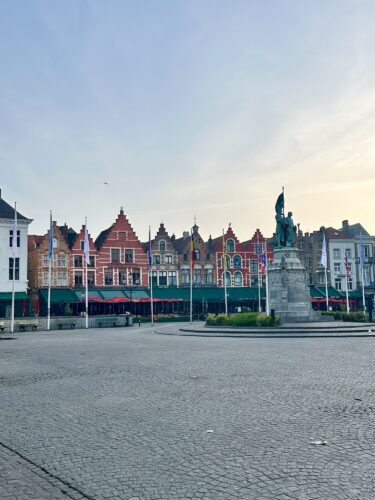
Even if you just stand in the middle of the Markt and slowly turn around, you get a sense of how extraordinary this city is. Every building has a story. Every roofline is worth looking at. And rising above it all, impossible to ignore, is the Belfry.
Climb the Belfry
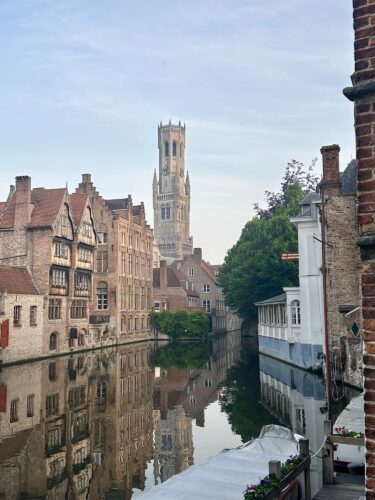
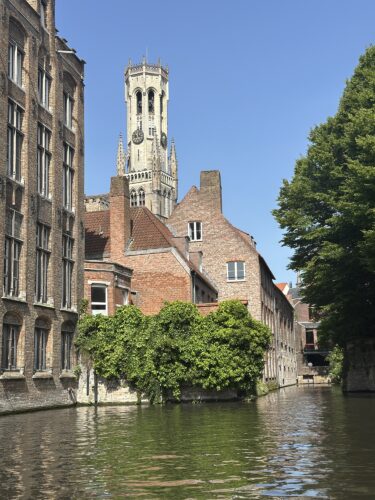
The Belfry is 83 metres tall and has dominated the Bruges skyline since the 13th century. It housed the city’s treasury, its town charter, and its famous carillon of bells, which still ring on the hour and play concerts on summer evenings. It is, in every sense, the symbol of the city.
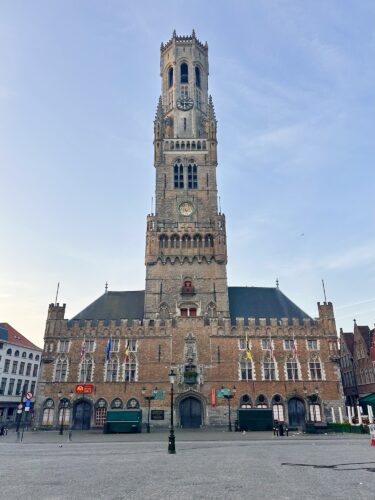
I climbed the Belfry, and I will be honest with you: it is 366 steps and they are narrow and steep and at certain points you are squeezing past people coming the other direction on a staircase that feels like it was designed for people considerably smaller than most modern tourists. There is also a famous treasury chamber halfway up, and a room where you can see the mechanism of the carillon and the enormous bells up close, which is genuinely fascinating and worth pausing for.
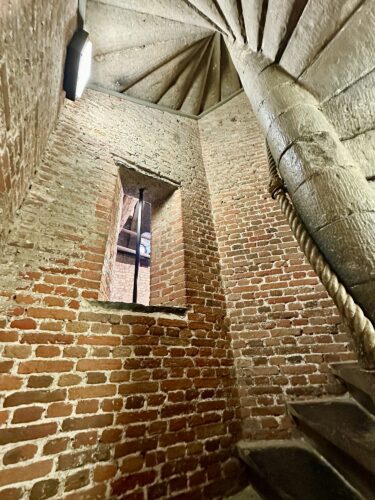
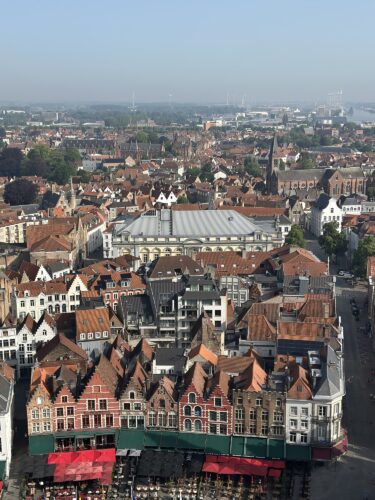
But the view from the top is worth every single one of those steps. You can see the entire city spread out below you, the canal network glinting in the light, the rooftops stretching out in every direction, the spires of the Church of Our Lady and the Church of Saint Salvator rising above the surrounding buildings. On a clear day you can see the Belgian countryside stretching out toward the coast. Take the climb slowly, enjoy the carillon bells if they ring while you are up there, and make sure your phone is charged because you will take a hundred photos.
Tickets for the Belfry can sell out, especially in peak season. Booking ahead online is worth doing.
Boat Tour: Get There Early
One of the best things you can do during one day in Bruges is take a boat tour through the canals. I cannot overstate how different the city looks from the water. Streets and bridges that seem ordinary on foot become magical from a low flat-bottomed boat gliding underneath them. You pass under stone arches, alongside the backs of historic buildings, through quiet stretches where the water reflects the sky and the trees and you feel like you have slipped briefly into another century.
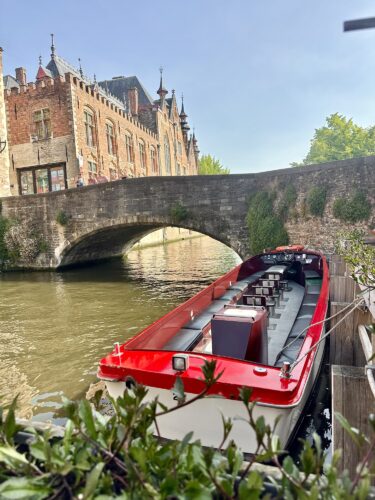
The boat tours operate from several spots around the canal network and they open at 10am. If you are visiting on a weekend, I would strongly advise arriving right at opening time or even a few minutes before. The queues build up quickly, and you could find yourself waiting 30 to 45 minutes if you show up at 11. I got there shortly after opening and was on the water within a few minutes. The tours run for about 30 minutes and the guides are knowledgeable and entertaining, with a good balance of history and humour.
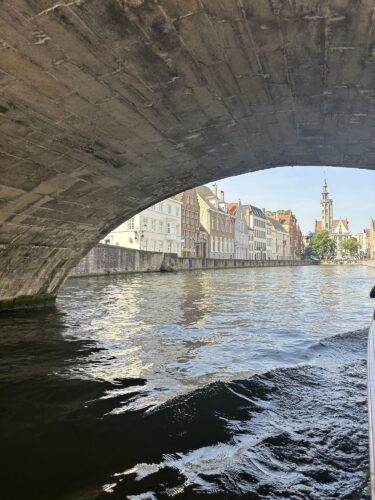
One practical tip: the boats are uncovered, so if the weather is even slightly cool or cloudy, bring a layer. The breeze off the water feels colder than you expect.
This is one of those experiences that is entirely worth any queue you have to endure. Do it.
The Church of Our Lady
A short walk from the canal boat departure points, the Church of Our Lady is one of those stops that feels almost quietly unmissable. The church’s spire, at 122 metres, is the tallest brick structure in the world, which is remarkable enough, but the reason most visitors come is for a single artwork inside: Michelangelo’s Madonna and Child.
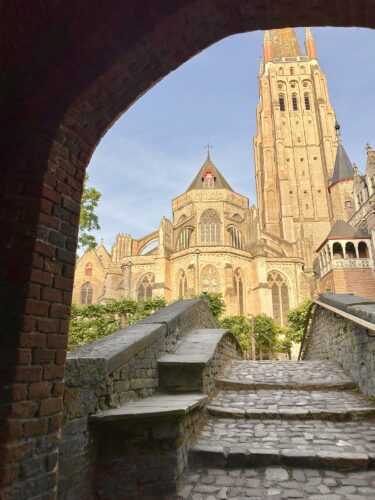
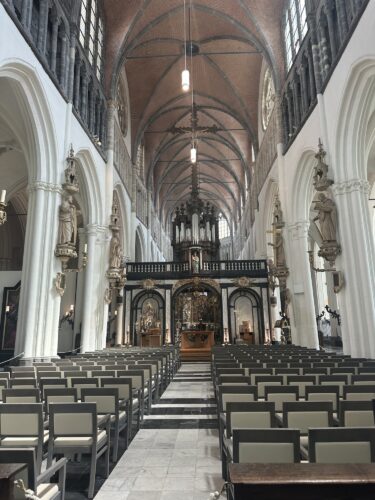
It is a small white marble sculpture, relatively modest in scale compared to what you might expect from one of history’s greatest artists, and yet it is deeply moving. It is one of only a handful of works by Michelangelo that left Italy during his lifetime, sold to a Bruges merchant family in the early 16th century and donated to the church shortly afterward.
Standing in front of it in this medieval church in a small Belgian city, you feel the weight of history in a way that does not happen very often. The tenderness in the figures, the way the child leans against the Madonna’s knee, the extraordinary quality of the carving in the drapery. Go in, take your time, let it land.
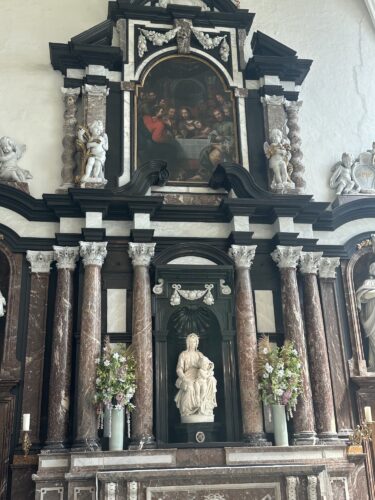
The church also contains the elaborate mausoleums of Charles the Bold and Mary of Burgundy, two of the most powerful rulers of medieval Flanders, complete with gilded effigies. Another layer of history that rewards anyone who lingers.
The Basilica of the Holy Blood
One thing that catches a lot of visitors off guard about the Basilica of the Holy Blood is that there are actually two distinct spaces to explore: a lower Romanesque chapel and an upper Gothic chapel. Both are free to enter, and both are completely worth your time.
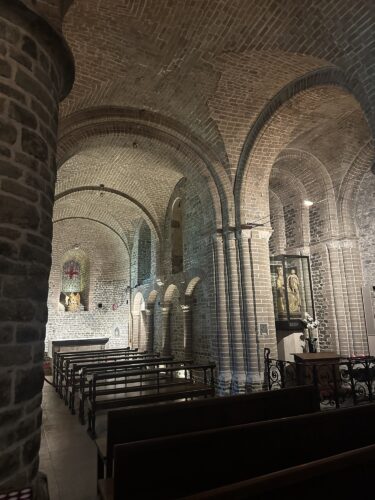
The lower chapel dates from the 12th century and is one of the oldest and best-preserved Romanesque interiors in Belgium. It is dark, spare, and ancient-feeling in the best way. The stone is raw and undecorated, the proportions are low and heavy, and the atmosphere is unlike anything else in the city. It feels genuinely old in a way that even old buildings sometimes do not.
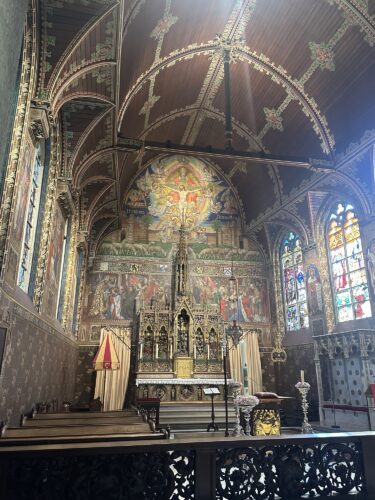
The upper chapel is a complete contrast: a riot of neo-Gothic decoration, gilding, and stained glass, rebuilt in the 19th century in a style that leans into colour and ornament. It houses the relic of the Holy Blood itself, a phial believed to contain a drop of Christ’s blood brought back from Jerusalem during the Second Crusade in the 12th century. Whatever your beliefs, the history layered into this small building is extraordinary. The relic is displayed for veneration every Friday.
Do not make the mistake of dipping your head in the door, seeing one level, and leaving. Both levels are part of the experience, and the contrast between them tells you something about how Bruges itself has changed and endured over the centuries.
Lunch: Rooftop Views Over Bruges
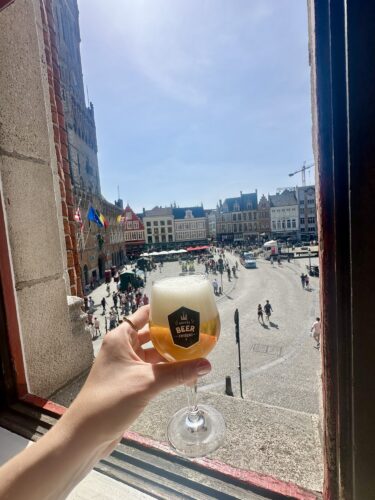
By mid-morning I was ready to rest my feet and eat something, and I found a rooftop restaurant that turned out to be one of the highlights of the day. Bruges has several rooftop and elevated dining options, and I would strongly recommend making time for one of them. After spending the morning looking up at towers and bridges from street level, eating lunch with a view over the rooftops was a genuinely lovely shift in perspective. The terracotta rooflines, the church spires, the flat Belgian sky. It felt like a reward for all the walking.
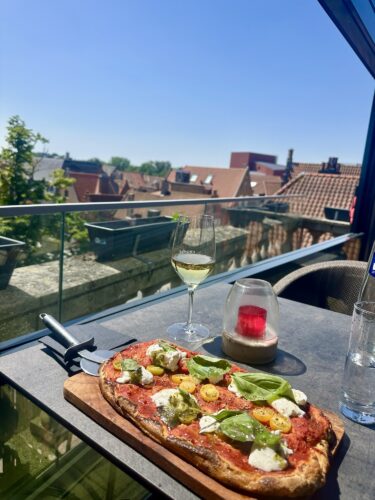
Belgian food in general is worth embracing and there is almost nowhere in the city that will serve you a bad meal. Bruges is not a city that has turned entirely to tourist food. There are enough local restaurants and proper Belgian cafes to eat well wherever you end up.
Take your time over lunch. Order a Belgian beer if that is your thing. Bruges is not a city to rush through, and a longer midday break actually sets you up well for an energetic afternoon of museums, shopping, and chocolate.
Afternoon: Museums and Belgian Culture
Bruges has a genuinely impressive range of museums for a city its size, and you could easily spend an entire day just working through them. Since I had one full day, I had to be selective, but here are the ones I would point you toward.
For beer lovers:
- The Bruges Beer Experience on the Breidelstraat is a self-guided interactive museum that takes you through the history and brewing process of Belgian beer. It is well put together and finishes with a tasting, which is always the right way to end a museum visit. Belgium takes its beer seriously, and this is a great way to understand why.
- De Halve Maan Brewery is the other great option, and it is one of the few remaining family breweries operating in the city centre. Their guided tours are popular and take you through the full brewing process, finishing of course with a glass of their flagship Brugse Zot. Book ahead if you can, especially at weekends.
For chocolate lovers:
- The Choco-Story chocolate museum is a fun and genuinely informative look at the history of chocolate from its origins in Mesoamerica through to the development of Belgian pralines. It ends with a chocolate-making demonstration and tasting. Even if the museum itself does not appeal, the tasting alone justifies the entrance fee.
For history and art lovers:
- The Groeningemuseum houses a world-class collection of Flemish Primitive paintings, including masterpieces by Jan van Eyck, Hans Memling, and Gerard David. The Flemish Primitives were among the most technically innovative painters of the 15th century, and seeing their work in the city where much of it was created is a different experience from seeing it anywhere else. If you have any interest in medieval and early Renaissance art, do not skip this one.
- The Historium Brugge is a more theatrical, immersive experience that takes you through the story of the city’s medieval golden age using costumed guides, atmospheric sets, and audiovisual storytelling. It is particularly good if you are travelling with children or want some historical context before you explore the rest of the city.
- Museum Sint-Janshospitaal, housed in a 12th century hospital building that itself is remarkable, combines the Hans Memling collection with a fascinating look at the history of medicine and care in medieval Bruges. The building itself is worth seeing even if museums are not your thing.
You will not get through all of them in an afternoon. Pick two that appeal to you and go in properly rather than rushing through several. Better to spend an hour somewhere and leave having actually absorbed something than to spend fifteen minutes in five different places.
Chocolate Shopping: A Bruges Essential
This is not optional. You need to buy Belgian chocolate in Bruges, full stop.
The city has an extraordinary concentration of chocolate shops, ranging from large artisan producers with beautiful shopfronts to tiny family-run ateliers where you can watch the chocolatiers at work through the window. The quality is consistently high, and the range is staggering. Dark chocolate with salted caramel. Milk chocolate pralines. White chocolate truffles dusted with cocoa. Speculoos-filled ganaches. Gianduja. Champagne truffles. Single-origin bars made with cacao from specific farms. I could go on.
My advice: walk around before you commit. There are dozens of shops within a few streets of the Markt and along the lanes leading toward the Burg, and it is worth looking at a few before you buy. Some of the most famous names, like The Chocolate Line or Dumon, have built excellent reputations for good reason. Others are smaller and less known but equally good. The act of browsing is part of the pleasure.
I ended up with two boxes to bring home and genuinely wish I had bought a third. Belgian chocolate travels well if you keep it cool, and it makes a wonderful gift that every single person you give it to will appreciate. I have yet to meet someone who received a box of genuine Bruges chocolates and was anything other than delighted.
One small tip: buy a few individual chocolates to eat on the spot as well. Do not wait until you get home to enjoy them.
Shopping in Bruges
Beyond chocolate, Bruges has a genuinely enjoyable shopping scene that often gets overlooked in favour of the sightseeing. The streets around the Markt and the Steenstraat, the main shopping street running south from the square, are full of independent boutiques, lace shops, homeware stores, bookshops, and fashion retailers.
Bruges lace deserves a special mention. Handmade Bruges lace is one of the great traditional crafts of Belgium, and while there is a lot of mass-produced imitation lace sold in tourist shops, the real handmade stuff is extraordinarily beautiful and worth seeking out. The Lace Centre on the Balstraat gives demonstrations and sells authentic pieces, and a visit there gives you a much better eye for quality when you are browsing elsewhere.
The Dijver antique and flea market, which runs along the canal on weekend afternoons, is also worth a look if you are in the city on a Saturday or Sunday. Prints, vintage maps, old books, jewellery, and all kinds of curios spread out along the canal bank with the Groeningemuseum in the background. Even if you do not buy anything, it is a lovely atmosphere.
If you have an hour to spare after your museums and canal walks, just wander and see what catches your eye. I find that unstructured shopping time in a beautiful European city is one of the quiet pleasures of travel. No agenda, no list, just looking.
What to Bring on Your Trip to Bruges
A few practical things that will make your day in Bruges smoother:
- Comfortable walking shoes. The city is almost entirely navigated on foot over cobblestones. Trainers or cushioned walking shoes are essential. Anything with a heel will make you miserable by lunchtime, and the cobblestones are genuinely uneven in places. This is not negotiable.
- A light jacket or layer. Belgium in late May was warm but with a cool breeze, especially near the water. The boat tour in particular can feel chilly once you are moving. Pack a layer you can tie around your waist and forget about until you need it.
- Cash. Many of the smaller chocolate shops, boat tours, and market stalls either prefer or require cash. Card payments are widely accepted in restaurants and larger shops, but do not rely on it everywhere. Bring some euros.
- A portable charger. You will take more photos than you expect. The Belfry view alone will drain half your battery. Keep your phone alive.
- A small tote bag or backpack. Between the chocolates, any shopping, a jacket, and a water bottle, you will want somewhere to put things. A lightweight foldable bag takes up almost no space in your luggage.
- Sunscreen. If you are visiting in late spring or summer, the days can be genuinely sunny and warm. Walking for hours on cobblestones with no shade catches people out more than you would expect.
- An early alarm. Not a physical item, but the single most important thing you can bring. Set it for 7am, get out before the crowds, and see the city as it was meant to be seen: quiet, glowing, and almost entirely yours.
A Few Things Worth Knowing Before You Go
No travel guide is complete without the slightly unglamorous practical information, so here it is.
The city centre is compact and walkable. Almost every major sight is within about 20 minutes on foot from the Markt, which means you do not need public transport within the city at all. Wear good shoes and walk everywhere. That is both the practical advice and the point. The walking is not the means of getting to Bruges. The walking is the experience.
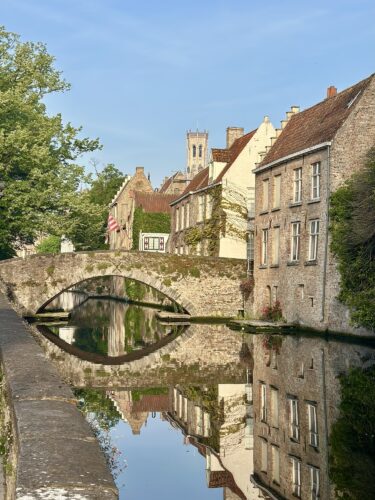
Bruges is busiest between June and August, but late May is already very much peak season. If you can visit on a weekday rather than a weekend, you will find it noticeably less crowded, especially at the boat tours and the Belfry. Arriving early in the day makes a bigger difference than almost any other planning decision you can make.
Most sights accept card payments now, but the boat tours I used were cash only. Keep some euros on you to avoid disappointment at the jetty.
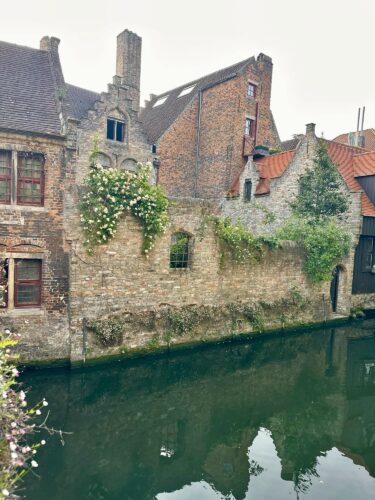
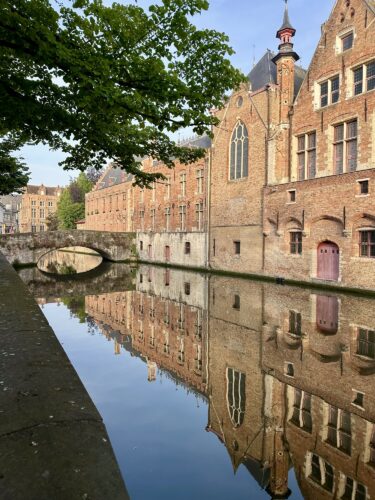
Finally: give yourself permission to do less than you planned. Bruges rewards slowness. The temptation is to fill every hour with a new museum or church or landmark, and you absolutely can do that if that is how you travel. But some of the best moments I had in the city were unplanned. Sitting by a canal with a coffee watching the swans go past. Wandering down a lane I had not been down before and finding a row of perfect 16th century houses reflected in the water below. Standing in the Markt at dusk after the crowds had thinned, looking up at the Belfry lit against a darkening sky. Those moments do not happen if you are always already moving to the next thing.
Go Spend One Day in Bruges
I came to Bruges with fairly high expectations and left with those expectations exceeded. Two nights was the right amount of time for me, one full day of exploring felt sufficient to cover the highlights without feeling frantic, and the train from Brussels made the whole thing logistically simple and stress-free from start to finish.
Is it busy? Yes. Is it touristy? Absolutely. Does it matter? Not even slightly. Bruges has earned its crowds. The canals are genuinely stunning. The Markt is one of Europe’s great public squares. The churches are extraordinary, and two of them contain artworks that would be the highlight of any major international museum. The chocolate is world-class. The beer is world-class. The architecture is world-class. And at 7am on a quiet morning, when the mist is still sitting on the water and your footsteps are the only sound on the cobblestones, it is one of the most peaceful and beautiful places I have ever stood.
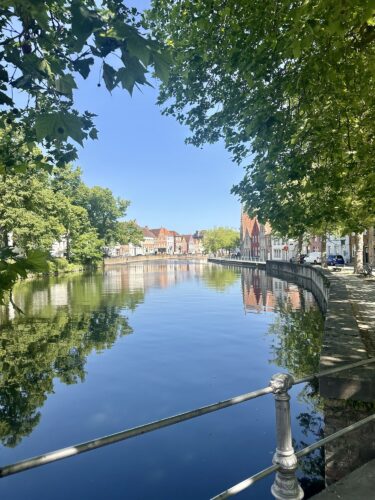
One day in Bruges is enough to fall in love with it. It is probably not enough to feel like you have done it justice. That is, I think, precisely the point. You go, you see it, and you start planning when you can come back.
Go. Get up early. Climb the Belfry. Take the boat tour. Eat the chocolate. You will not regret a single moment of it.
With love,
Bri and Cat
Affiliate Disclaimer:
As an Amazon Associate I earn from qualifying purchases. This comes at no additional cost to you. We only recommend products that we believe will add value to our readers.
Leave a Reply